Booking choice: The Civita and Tuscany day trip, from $99 per person. Check dates Tour details
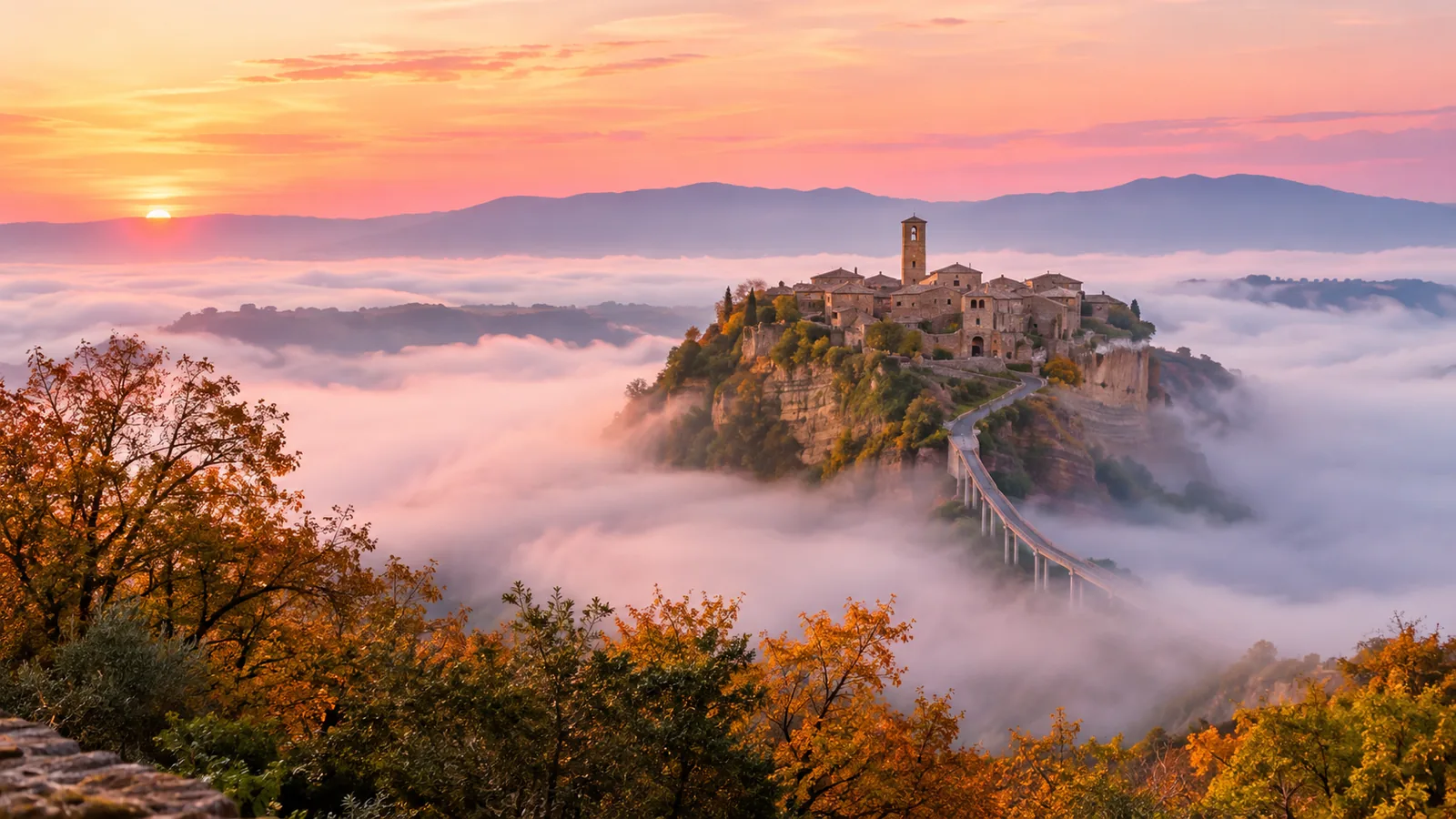
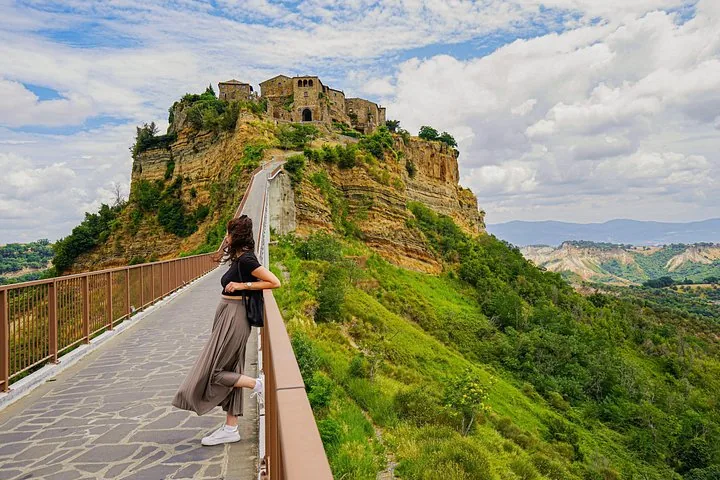
Civita was once joined to Bagnoregio by a ridge of land. The 1695 earthquake broke it, and the slopes have kept retreating since. A masonry bridge built in 1923 was partly blown up by retreating German troops in 1944; the reinforced concrete footbridge you walk today opened in 1965, according to Italia.it.
Accessibility details come from the town's page on transport for disabled visitors and its ticket rules, checked on 10 October 2026, plus what guests write in GetYourGuide and Viator reviews.
The quick answer
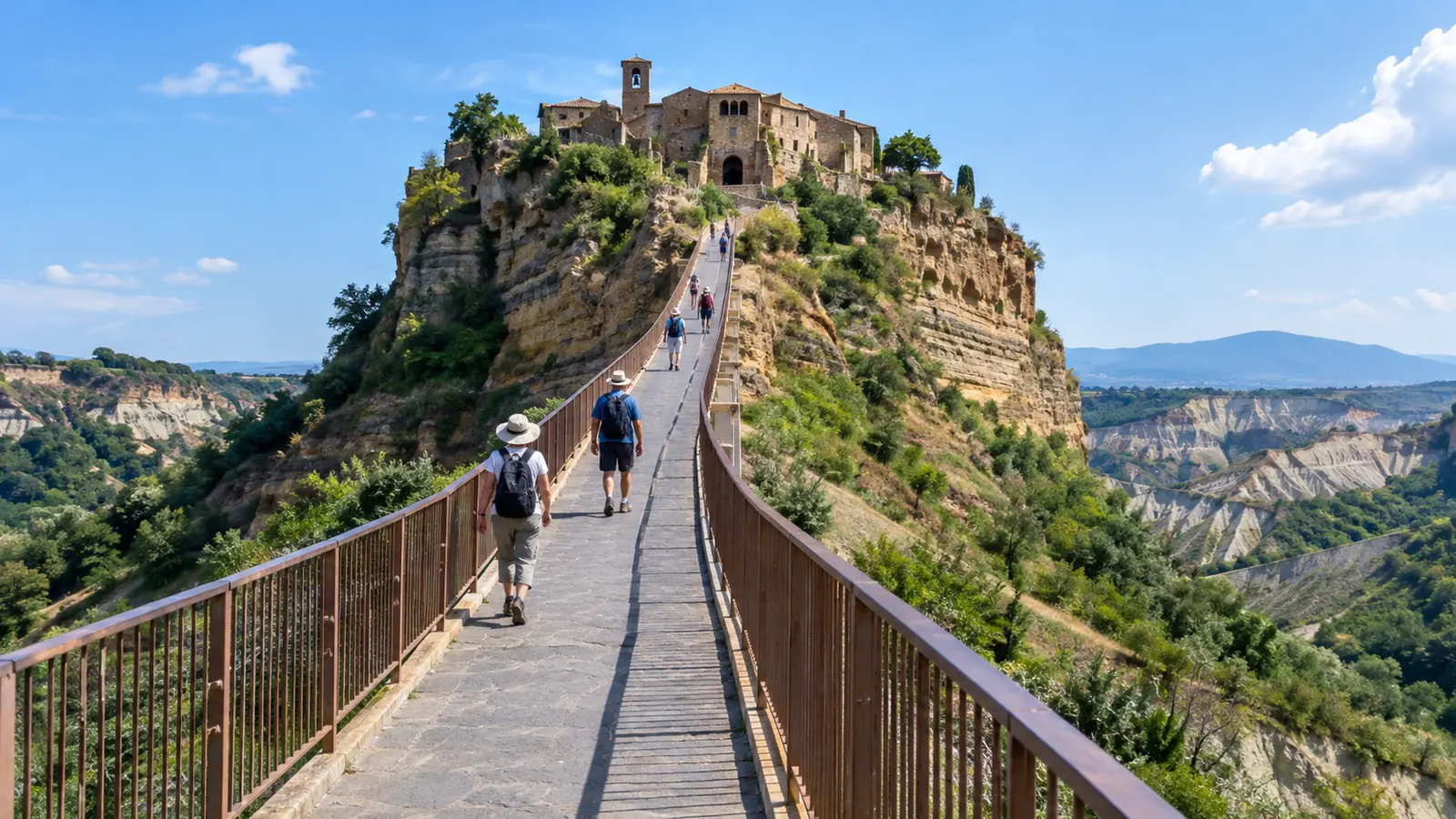
The bridge is about 300 metres long, pedestrian only, and steep in its last stretch up to the gate. Fit adults take 10 to 15 minutes. People with severe mobility problems can use a free transport service run by the Red Cross with the town: every Saturday and Sunday from the start of the bridge, other days booked two days ahead. Holders of a 100% disability card and one companion enter free.
How long is the bridge to Civita di Bagnoregio?
About 300 metres. A 450-metre figure also circulates, but the official tourism portal and most sources give 300.
Italy's official tourism portal, Italia.it, calls the bridge 300 metres long, and so do the GetYourGuide listings and most guides. The 450-metre figure that turns up on a few sites probably counts the path down from the Belvedere as well. For planning, it makes no difference: you walk about 300 metres of bridge and a few hundred more of path and lanes.
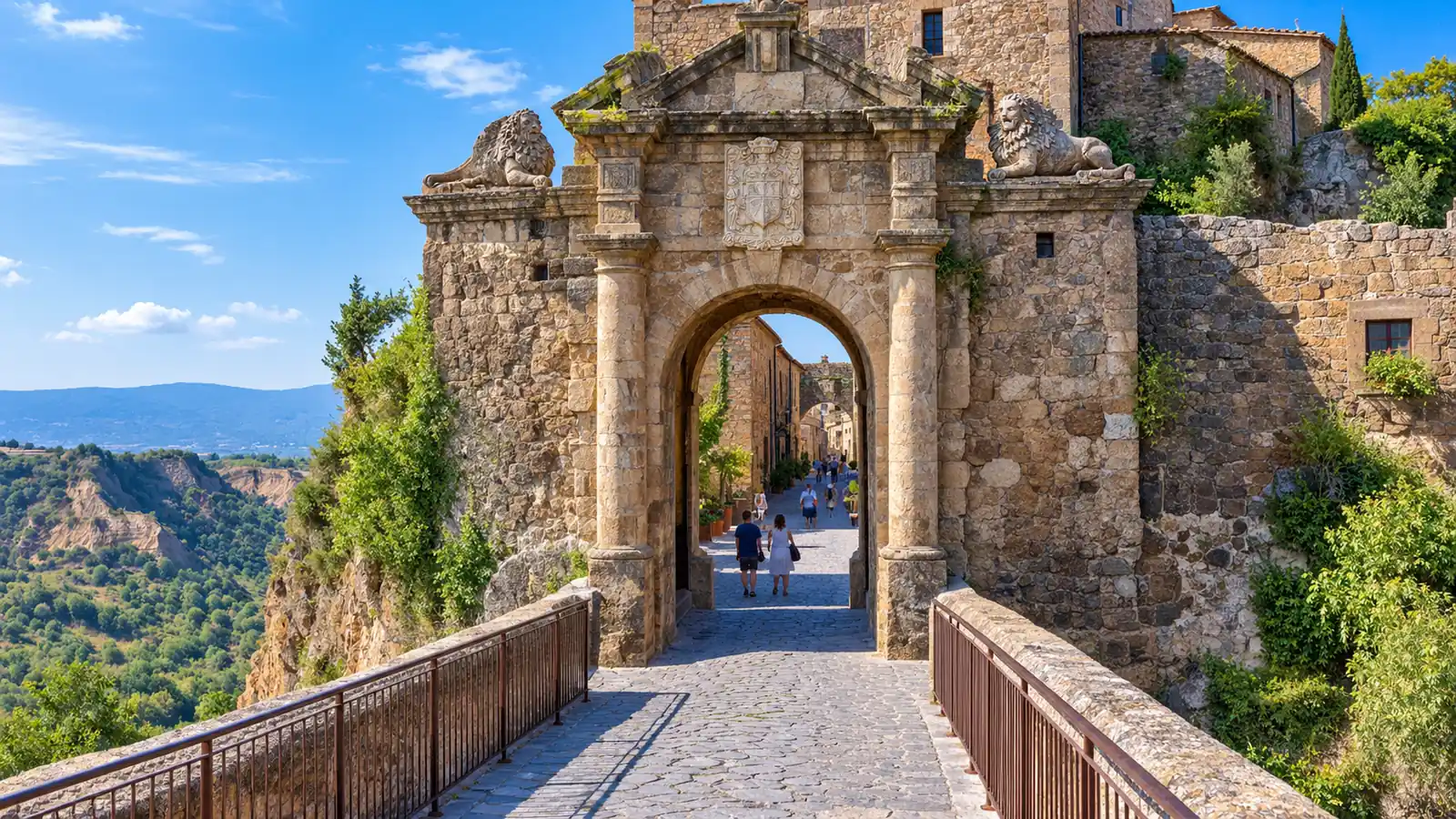
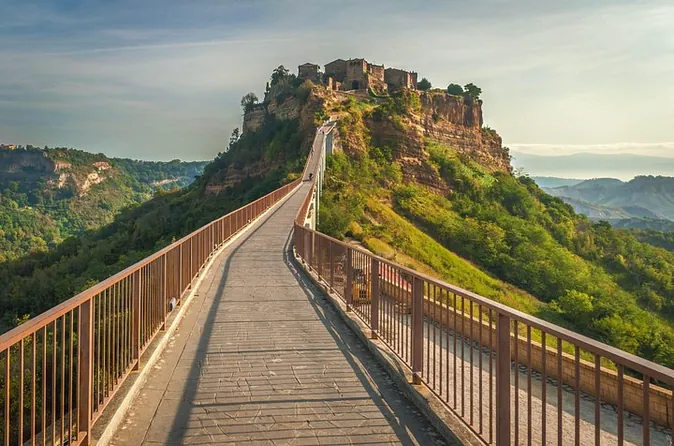
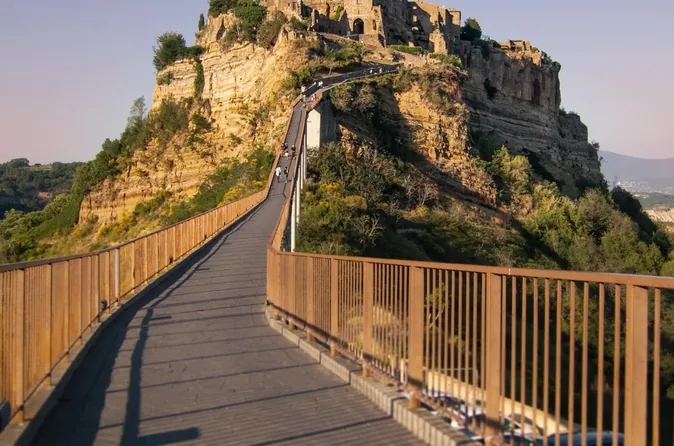
The bridge is not flat. From the Belvedere the path drops to the lowest point, then the bridge climbs across the gap to the Porta Santa Maria, gently at first and then steeply for the last part. Coming back, you go down the steep part and then climb again to the Belvedere. Neither direction is easy for anyone who struggles with slopes.
| Fact | Detail |
|---|---|
| Length | About 300 m (Italia.it); some sources say 450 m |
| Built | 1965, reinforced concrete, pedestrian only |
| Earlier bridges | Masonry bridge of 1923, partly blown up in 1944; wooden walkways after |
| Surface | Concrete with railings both sides, no steps on the bridge |
| Gradient | Gentle at first, steep in the last stretch to the gate |
| Shade, toilets, benches on the bridge | None |
| Vehicles | Residents' small carts and authorised vehicles only |
How hard is the walk, and how long does it take?
Moderate for fit adults, hard for anyone with heart, knee or breathing problems. Allow 10 to 15 minutes up, more in heat.
Guests are honest about it. On the Tour Guy's trip, Rafael C wrote in October 2026: "The walk to Civita was strenuous. The guide warned the group in advance, and that was very much appreciated." George K, in September 2026: "Even with the shuttle bus, there is still a strenuous walk to Civita di Bagnoregio, so make sure you wear appropriate shoes." Kelly, who bought the GetYourGuide ticket, found it easier: "The walk to/from is not that difficult."
Both are true. A fit adult walks it in 10 to 15 minutes and stops at the top for the view, not for breath. Someone who rarely walks uphill will need rests, and there are no benches on the bridge. Add the walk from the car park or the bus stop in Bagnoregio, and the round trip on foot easily takes an hour, with a steep climb at each end.
| Leg | Distance (approx.) | Time | Effort |
|---|---|---|---|
| Piazzale Battaglini to the Belvedere | Through the old town | 15 min (or €1 shuttle) | Flat to gentle |
| Belvedere down to the foot of the bridge | A few hundred m | 5 min | Downhill, steep in places |
| Footbridge up to the gate | About 300 m | 10 to 15 min | Steep at the end |
| Inside the village | About 300 m end to end | 10 min each way | Uneven stone, some steps |
| Return to the Belvedere | Same in reverse | 15 to 20 min | Steep climb at the end |
Can wheelchair users visit Civita?
Yes, with the free Red Cross transport service. Pushing a wheelchair up the bridge is not realistic for most people.
The town and the Bagnoregio and Lubriano section of the Italian Red Cross run a free transport service to Civita for people with severe motor disabilities. It runs every Saturday and Sunday from the start of the bridge. In the most serious cases they can collect from Piazzale Battaglini on request. On other days it works on call and must be booked two days ahead. The phone number for the local Red Cross is on the town's disability page.
Entry is free for holders of a 100% disability card and one companion. Inside the village the main street is paved but uneven, with old stone and some slopes, and the side lanes have steps. A wheelchair user can reach the square and the main street with help; the caves, cellars and the far viewpoints are mostly out of reach. The living nativity at Christmas also arranges accessible transport across the bridge.
Group tours are not set up for wheelchairs. The City Wonders, Assisi and Villa Lante listings say they are not suitable for wheelchair users, and the Villa Lante trip also excludes people with mobility impairments and anyone over 70.
| Need | What exists | How to arrange |
|---|---|---|
| Severe motor disability | Free Red Cross transport to Civita | Sat and Sun at the bridge; other days book 2 days ahead |
| Very severe cases | Pickup from Piazzale Battaglini | On request through the same service |
| Entry ticket | Free for 100% disability card + 1 companion | Show the card |
| Group tours from Rome | Not wheelchair accessible | Choose a private driver instead |
| Inside the village | Paved main street, uneven; steps elsewhere | Bring a strong companion |
Can you take a stroller or small children?
Yes, with a sturdy stroller and a strong pusher, or better, a baby carrier. Children under 6 go in free.
Parents do take strollers across, and the bridge has no steps. The issue is the gradient at the end and the stone inside the village, which is rough on small wheels. A carrier is easier for babies and toddlers. Children under 6 pay nothing, with ID showing their age.
For older children the bridge is the highlight: a walkway in the sky with a village at the end. Hold hands near the railings on windy days, and keep them on the main lanes inside, where the edges are walled. In summer bring water and hats; there is no shade on the bridge and very little on the way down from the Belvedere.
What about older visitors and people who tire easily?
Take the shuttle from Piazzale Battaglini, go early or late in the day, and allow time to rest at the gate.
The first trick is to save the flat part. The €1 shuttle from Piazzale Battaglini to the Belvedere removes the 15-minute walk through town each way, and drivers can drop passengers at the shuttle stop before parking. The second is timing: before 10:00 or after 17:00 the bridge is cooler and quieter, so you can stop without blocking anyone.
Choose the tour with care. The Tour Guy's Civita and Tuscany trip includes the shuttle and warns guests about the walk in advance, which reviewers appreciated. The Assisi, Civita and Orvieto tour lists itself as not suitable for people with a low level of fitness and gives under an hour in Civita, which turns the bridge into a race. A private driver can wait while you take your time and drop you at the closest legal point.
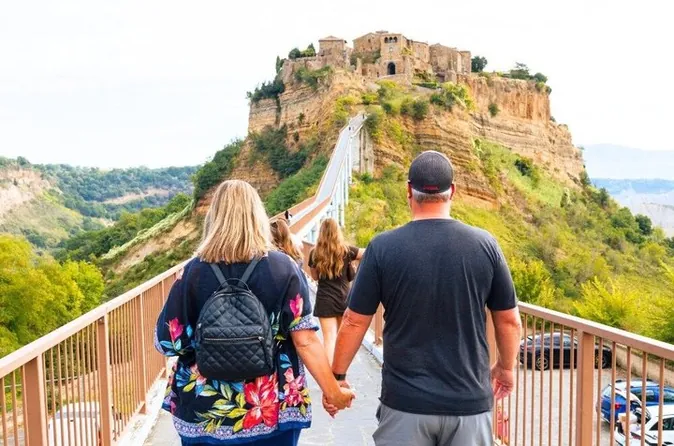
Civita with the shuttle and entry included, then a winery lunch near Montepulciano and an hour in Pienza.
Check dates Tour detailsWhat should you wear and bring?
Shoes with grip, water, a hat in summer and a layer for the wind. Leave large bags behind.
The bridge is concrete, but the lanes inside are worn tuff and stone, slippery after rain and polished by millions of feet. Trainers or walking shoes beat sandals. In summer, carry water from Bagnoregio: there is nowhere to buy it on the bridge. The bridge is exposed, and the wind across the valley can be cold even when Bagnoregio feels mild.
Do not bring a suitcase. There is no left-luggage office, and dragging a case up the last stretch is miserable. The Civitavecchia shore tour asks guests not to bring large bags for the same reason. With good shoes and an early start, the bridge is part of the pleasure: the village gets closer and higher with every step. The best time guide helps you pick the cool hours.
Shuttle and entry included, with a guide who warns you about the climb before you start.
Check datesFrequently asked questions
How long is the bridge to Civita di Bagnoregio?
About 300 metres. It is pedestrian only and steep in the last stretch to the Porta Santa Maria gate. Most people walk it in 10 to 15 minutes.
Is Civita di Bagnoregio wheelchair accessible?
Not on your own. The town and the Red Cross run a free transport service for people with severe motor disabilities: every weekend from the bridge, and on other days if booked two days ahead.
Is there a shuttle to Civita di Bagnoregio?
A local shuttle (about €1) runs from Piazzale Battaglini to the Belvedere in Bagnoregio. No vehicle crosses the bridge except residents' carts and the Red Cross service.
Can you cross the bridge to Civita with a stroller?
Yes, it has no steps, but the end is steep and the lanes inside are rough stone. A baby carrier is easier.
Ready to book
Book your visit
Free cancellation up to 24 hours before on every option. Prices are from-prices in USD and move with the season.
Civita, Montepulciano & Pienza Day Trip with Lunch
Civita plus Tuscan wine and Pienza, with the shuttle included
Orvieto & Civita di Bagnoregio Private Tour from Rome
Your own driver and timetable, from your Rome hotel
Civita di Bagnoregio & Villa Lante Garden Day Trip
- Transport from Cinecittà metro (line A) and back
- Entry ticket to Civita di Bagnoregio
- Entry ticket to Villa Lante